
 Site is still under construction!
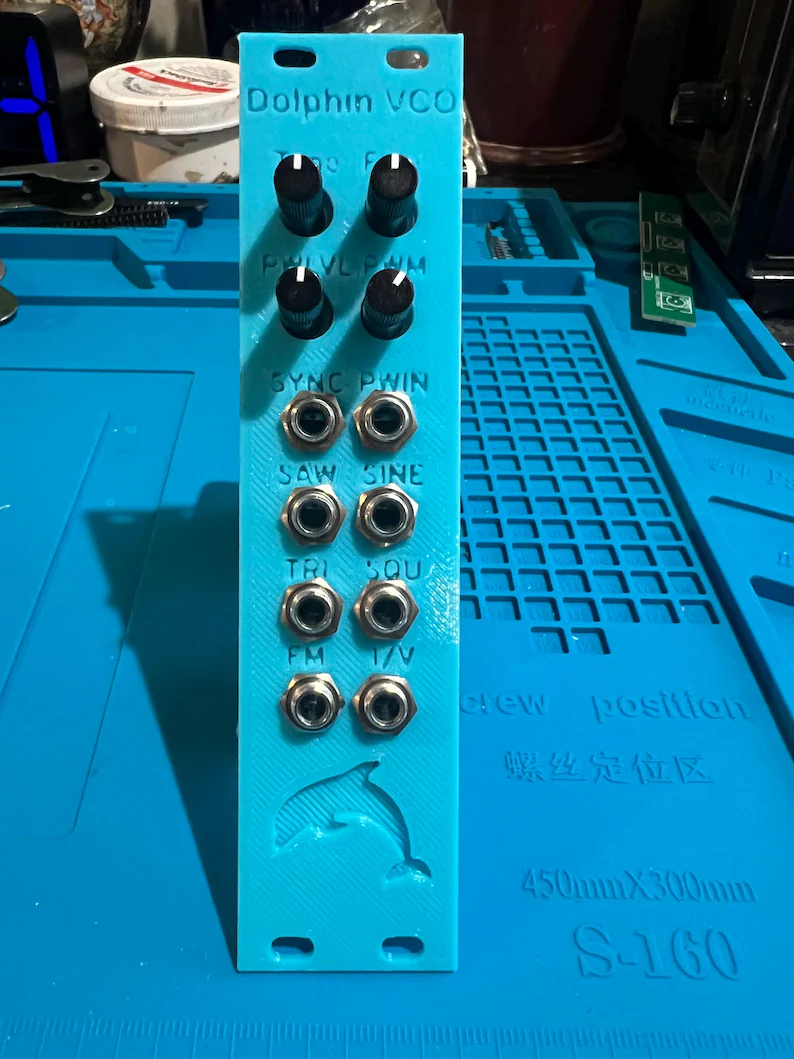
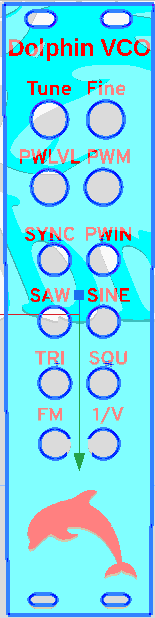
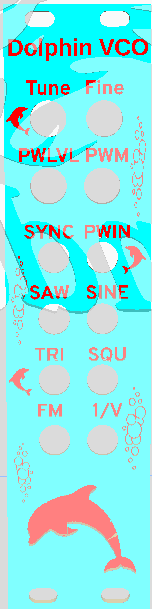
The Dolphin VCO is a AS3340 based VCO that has 4 waveform outputs (square, triangle,sine, and saw), and a 1/v, FM, sync, and Pulse Width Modulation input. The controls for the vco are a coarse tune knob, a fine tune knob, a Pulse Width control, and a attenuator for the Pulse Width Modulation input. The Dolphin VCO can be calibrated for for 1/v, as well as having trimpots to better shape the sinewave to preference. Modules runs on +/-12V power and is 6 HP. Guide can be found here
Creator commentary:
This is what I feel like is a pretty decent beginner's VCO and is what I had in mind when I was making it. It is inspired by Look Mum No Computer's VCO since it was a pretty good beginner's vco, and added a fine tune knob and a bunch of inputs for modulation to sweeten the deal for a beginner. I did intend for the VCO design to include an octave switch, two additional waveforms (that being reverse sawtooth and cosine), two different syncs and more parameters to calibrate the vco more specifically and with a more broad range. But because of costs, size, and never being able to get the octave switch working properly, I decided to not move on with them. But in my opinion, I feel like using a coarse tune knob as opposed to the octave switch is easier to use and calibrate. Plus you're able to sweep into any frequency you want a lot easier, and again, I have beginners and people barely starting modular synthesis in mind and making it not so daunting, especially calibration. I do want to add an additional trimpot for calibrating higher frequencies and is something I would test and add in a future redesign, as well as adding the two additional waveforms which I really want.
This is an important module to me because I remember many moons ago being inspired by Look Mum No Computer and making his VCO as my first module and it felt like the first caveman discovering fire and history changed. Looking back, I have no idea how I calibrated it to even play a C major scale, I just remember calibrating it was a process I never understood and spent literal days trying to figure it out. Eventually I did find Analog Output's calibration guide which was seriously a life saver where I can finally tune a VCO in like 5 minutes. I really credit Look Mum No Computer for this one, sure I did add on to it and improve some things here and there from the original design, but without his passion for synths and making silly videos on it and his projects, I wouldn't be making this website and trying to make affordable and beginner friendly modules for people that are getting into this beautiful hobby, and don't want to spend an arm and a leg for the most basic modules.

